Structural Failure!...My T-38 “There I Was” Story
Author: Gary Jones
I followed my dream of being an Air Force pilot like my uncle since I was 5 years old. I survived the ROTC pilot cuts of 1974-75 and finally after a year delay made it to UPT at Webb AFB in class 76-08. Graduation from UPT set the stage for the next 40 years of successful flying in the T-38, F-16, 727, A320, 757, 767, and 777. I had great instructors, mentors, and role models. I survived and was blessed.
My first assignment was a T-38 FAIP to Sheppard AFB/80th FTW. After the required training courses and T-38 PIT I started as a new T-38 FAIP in 90th FTS. I was there for a year as a 1st Lt when my most memorable T-38 sortie occurred.
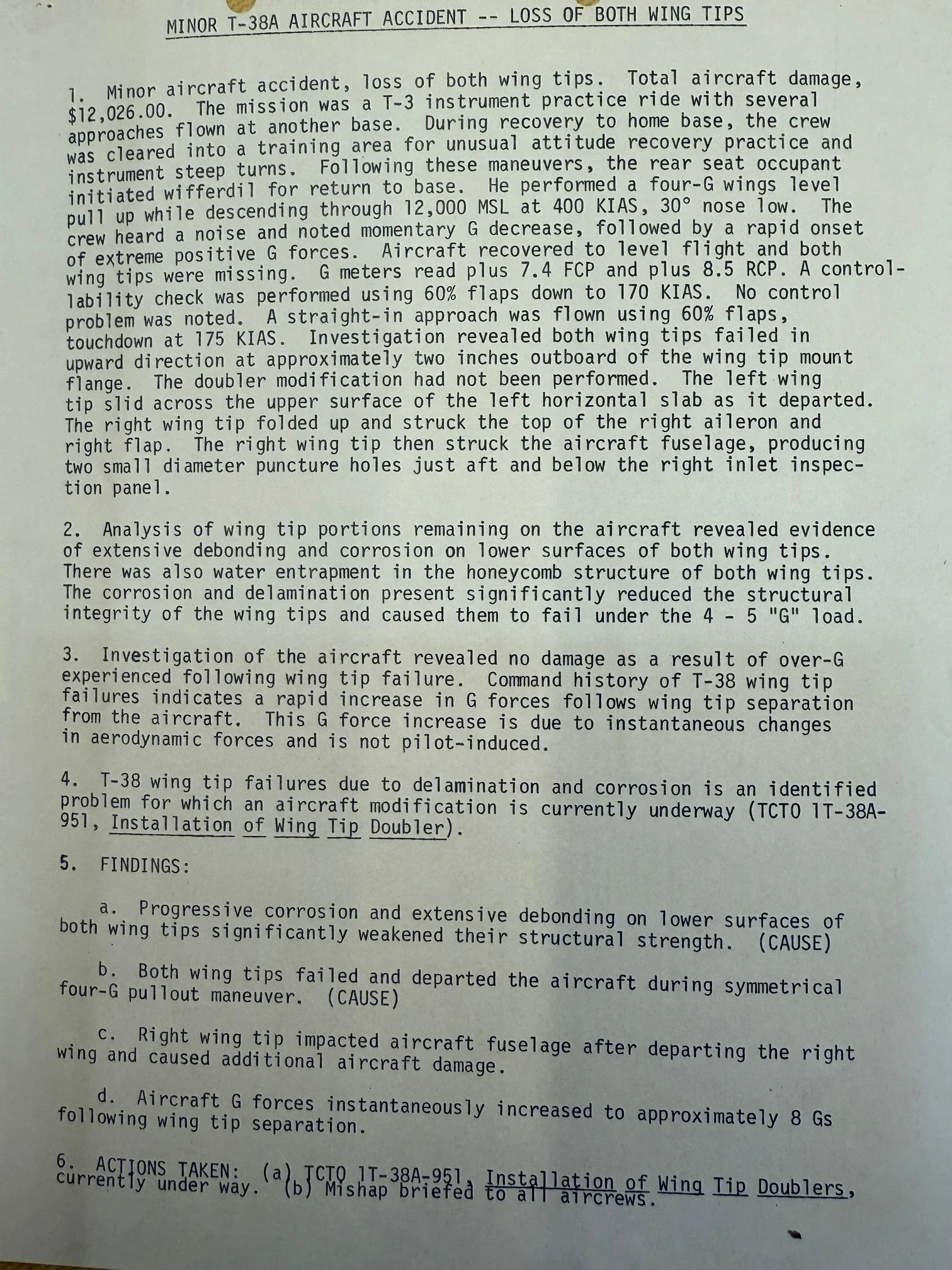
On 13 OCT 77 I was scheduled as the front seat safety pilot for a routine T-38 practice instrument ride. Capt Gene Bates was in the rear cockpit with the bag to practice for his upcoming instrument check. The weather was a cool fall afternoon with scattered clouds and perfect visibility. Great weather for instrument practice!
The plan was to fly to Dyess AFB for holding, penetration, approaches, then return to Sheppard for area work, practice approaches and landing. The takeoff, trip to Dyess, and back to the practice area south of SPS went as planned and was uneventful. Once back in the local area the plan was to practice steep turns, unusual attitude recoveries, and RTB to SPS for approaches and land.
Once established in the area we practiced steep turns. After that I took the aircraft and set up a nose low unusual attitude and recovery was normal. Next was the nose high unusual attitude and again recovery was normal. The nose high recovery left us high in the area with low airspeed so Gene kept flying the aircraft, pulled the bag back and began an energy gaining maneuver for RTB. Recovery from the maneuver started about 12,000', 400kts, and 30° nose low with a normal 4G pull.
This is where the "There I Was" story begins.
All of a sudden simultaneously within about one second…BANGWHAMBANG…accompanied by hard jolt thru the airframe and seat…accompanied by abrupt roll to right…accompanied by abrupt pitch up…accompanied by my head slammed down…followed by head back up and finally eyes back open. Gene instinctively rolled the jet back to wings level. A quick scan and everything looked normal, no lights, and both engines running OK. What the heck happened???
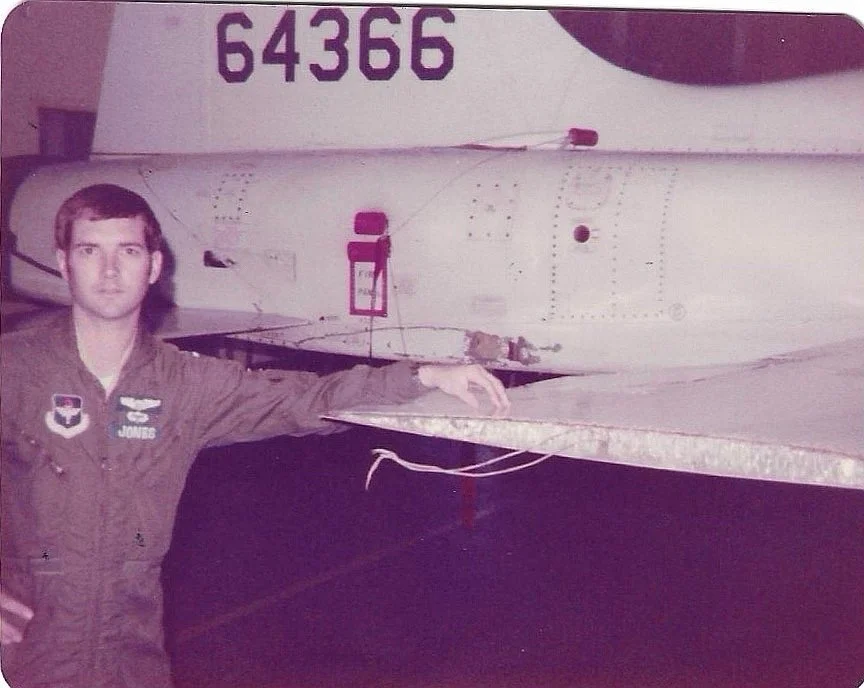
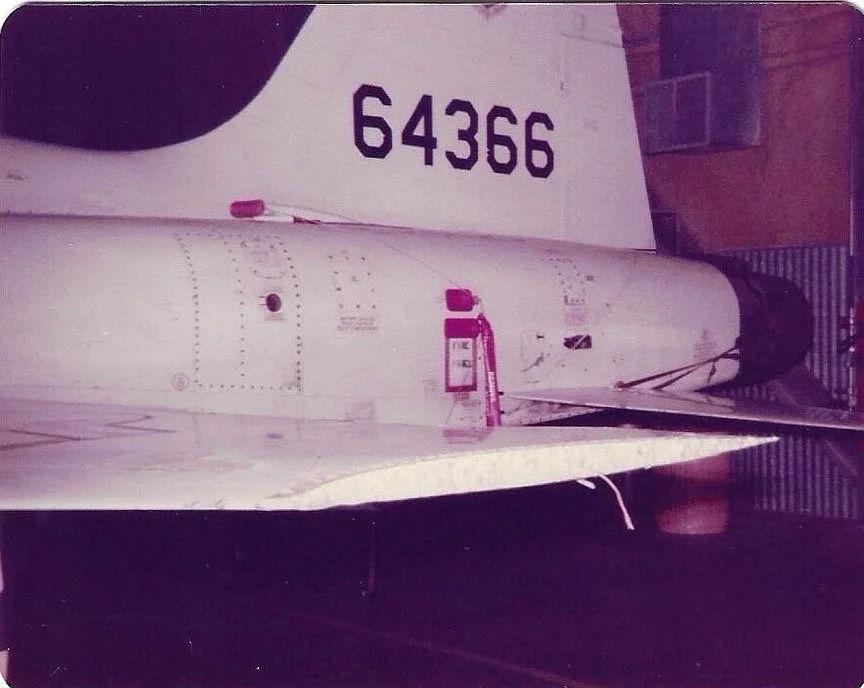
Then I see, 8Gs on the G meter. For some reason I looked over my right shoulder and that's when I saw it. What happened next, was nearly 50 years ago, but it is imprinted in my brain as if it was yesterday. I said "THE RIGHT WING TIP IS GONE!" Gene replied "NO, IT'S THE LEFT ONE!" A quick check over my left shoulder confirmed the left one was gone also. Man, the wings looked REALLY short!
After a few seconds of disbelief and probably some choice words we got our gyros re-caged and started working as a crew. I took over flying the jet while Gene took care of comms and checklist. As best as I can remember we maintained about 250kts around 15,000'. Gene declared an emergency and began coordinating with ATC and the SOF for recovery procedures and recommendations. We knew that there had been wing tip failures in the past but no one was aware of a double wing tip failure or of any specific recommendations for it.
We asked for a chase aircraft join on us but there was nothing available. With our fuel state we did not have time to wait for a chase to launch. As I recall we proceeded to the area just west of SPS for a controllability check where there was sparse population. We discussed the technique for the controllability check with the general idea of doing one thing at a time and slowing down slowly using 10kt increments. I don't remember any numbers except the final speed.
First while maintaining about 15,000 feet we got the gear out and had no issues with control. Next we extended flaps to 60. So far so good. Then we began to slow down using 10kt increments and momentarily stabilizing at each increment. We were stable with no control problems at 170kts. I remember saying "that's good enough for no flap landings so it's good enough for me". Gene agreed and we started the descent and headed for SPS with gear down and flaps 60 at some speed above 180kts. We used using very shallow bank angles. We lined up for about a 10 mile visual approach to 15R.
I flew the jet and Gene backed me up with airspeed and descent rate calls. Final approach was flown at 180kts with a planned touchdown no less than 170kts with minimum flare. Aerobraking would only be at touchdown attitude. I remember the jet seemed fairly easy to control on final. I don't remember any abnormal issues except for the big "pucker factor" of never doing it before and the unknown. I landed the jet as planned and lowered the nose. We were really going fast for a full stop landing. Thank goodness for that long SAC runway.
We finally got slowed down at the end but the brakes were hot. As we turned off at the end of the runway I remember seeing lots of cars and people standing on the side looking at us. We were directed to a spot for shutdown where we egressed normally. Then we were swarmed by lots of O-6s, O-5s, and other strap hangers. Lots more people than a 1st Lt would ever want for a landing greeting. We got lots atta' boys, congrats, and questions and finally a ride back to the squadron with the DO.
Post flight inspection revealed more airframe damage than was visible from the cockpit. The left wing tip hit the left stab and scraped the top surface as it slid back off the stab. The right wing tip folded up and over to hit the right aileron and flap. It then slid inboard to hit the fuse and punctured a large hole in the fuse side. It made a 3 foot long dent below the hydraulic site gauge. It then hit the right stab leading edge before sliding back off the stab. Fortunately all the flight controls continued to work normally. It would have been nice to know about the additional damage from a chase aircraft but it would not have changed the procedure or the outcome.
As far as I knew this was the first double wing tip failure. I never heard of another one but I lost contact with the T-38 world in 1980. About 3 months later I came to work and the wing safety officer said "come to my office I've got something for you". As I went in he presented me with two busted up T-38 wing tips with jagged metal edges and broken honeycomb aluminum. He said a rancher from south of the base called him and told him he found some airplane parts in his pasture. He said the cows were trying to chew on them and wanted to know if the Air Force wanted them back. I wish I had saved them or made a plaque with them but unfortunately after two PCS moves they went to a base dumpster.
In the late 70s wing tip failures were a known and ongoing issue with the T-38. Delamination and corrosion caused the wing tip skins to separate from the honeycomb cores and fail. There was a modification program that installed a doubler on the tip skins but our jet had not been modified yet. When the tip failure occurred under normal G load the aerodynamic forces on the jet instantly changed and caused an abrupt pitch up resulting in excess Gs. It was not the fault of the pilot and there was nothing the pilot could do.
Gene and I were recommended for some ATC command safety award but I never heard any more about it. About five months later we got a wing level individual safety award with a desk ball point pen. This was right after the engineering analysis report came out clearing us of any pilot responsibility for the incident. Someone later told me the submission for the command award was held back because the wing head shed thought that we were out screwing around and broke the jet. That stuff was way above my pay grade back then and I really had no clue.
It all turned out well for me in the end as I got my dream assignment to the first F-16 B-Course in 1980. Overall my time flying the White Rocket was an awesome and a great experience and I wouldn't trade it for anything.